
Staying with the trouble of AI
A meditation with technology, and an invitation to join me at today's conference on AI for the Rest of Us

“Interbeing is not a theory; it is a reality that can be directly experienced by each of us at any moment in our daily lives.”
-Thich Nhat Hanh, the 14 mindfulness trainings of the Order of Interbeing
Join me for today’s community conference, AI for the Rest of Us - more info and register free here!
Dear beloved reader,
I invite you to take a moment to experience a practice of remembering our interbeing through our engagement with technology (see end of the message for the transcript):
I should warn you, though, this meditation could be uncomfortable. If we look deeply at any one thing, we can see and experience our interbeing with all of life. We can sense it, we can feel it. This is also true of our technologies- and it’s true of both the beauty and pain of that connection.
When we look deeply, we can see the beauty of this connection - how we are able to connect around the world through words and screens - through these words, this screen.
When we look deeply, we can also see that this connection comes at a great cost - of extraction, exploitation, waste, injustice, violence, and abuse.
Sitting in this tension, holding the beauty of connection with the discomfort of the cost of it, is where possibility lies - possibility for other worlds to be born from the wreckage of this one.
Reckoning is necessary for a reimagining and rebirth.
There is a way in which we might think of technologies as “non-natural” because materials have been extracted in very exploitative ways, for both the earth and humans, and because humans have manipulated the materials. We can think of technologies as separate from us, but they are not, in any way.
All technologies come from the earth - from rare earth minerals, from fossil fuels, from water, from land. Their infrastructure is on land, and their usage, including their waste, requires vast resources, including energy and water.
If we look deeply at our technologies, we can see our deep interconnectedness with all of life - with minerals mined in the Congo, the workers who mined them, some of them children; with the factories producing our devices, likely in China, and the workers in suboptimal conditions assembling them; the water used to cool the massive amounts of data where our emails and photos - this message!- are stored, and on and on and on. Every step of the way, touching nearly every corner of the globe - but not equally or justly, as some bear the weight and cost of this disproportionately - our technologies come from land through labor with human hands.
The Coding Rights project Tech Cartographies: Your Cloud Is In Territories, visibilizes the ways in which “the cloud” is rooted in land, in the earth. The word “cloud” makes our data seem ethereal, nonexistent, but the “cloud” where we store all of our data, the cloud that holds the internet, is land-based. The project explores how:
It is a physical structure, geolocated and influenced by power dynamics. Cables, satellites, antennas, servers, computers, cell phones, extractivism, programmed obsolescence, electronic waste, running coding, content moderation... there is a lot of materiality and labor involved in making everything work! Who holds power over each segment of this complex structure? From which territories are the mineral resources being extracted for this technology to exist?
When we look deeply at our technologies, they can illuminate how we are connected with all of life. And when we sit with the discomfort of how these technologies come to be - the extraction, the labor abuses, the energy and water consumption, the waste - it forces us to look at the very fabric of modern life, how literally everything is structured, the thinking and ways of being embedded within it, and invites us to question and reckon with the foundations of the world we have created.
Other worlds are possible.
This is where my fascination and grappling with AI rests, at this edge of enchantment and disturbance. I have been in a deep inquiry around AI since January 2025, when I first stumbled into dreaming with chatbots and encountered AI’s liberatory and healing potential. I see the great potential for these technologies in terms of creativity and helping us learn to relate otherwise, and these technogies are born from and embedded within extremely extractive, oppressive systems. But looking deeply at the all of it is what is needed - looking at the interbeing and the nature of the relationships.
AI has become a scapegoat in a way. There are valid reasons to not engage with it, and I absolutely respect anyone’s decision to abstain and refuse engagement with AI. But there is a way in debates around AI that AI becomes the scapegoat for everything that is wrong with the modern world, as if we refuse to engage with it, it washes our hands clean of the damage being done through all our other technologies and facets of our modern lives (I don’t hear the same arguments about the ecological destruction of our streaming services, for example - no one wants to refuse Netflix).
However, our refusal doesn’t let us off the hook.
AI is a symptom and facet of broader extractive and exploitative systems that we are a part of and complicit in, whether we engage with AI or not. And what is demanded of us in this moment is the deep looking, grappling, and figuring out how we might learn to exist beyond these patterns of extraction and harm. Looking deeply, grappling, and acknowledging has to be part of the reckoning and finding paths beyond these extractive systems.
There is so much more to say about all of this, and it is what we will be talking about today, Sunday, February 8th - from 11am to 3pm eastern time (New York) at the AI for the Rest of Us community conference hosted by the Acosta Institute.
Registration is free!
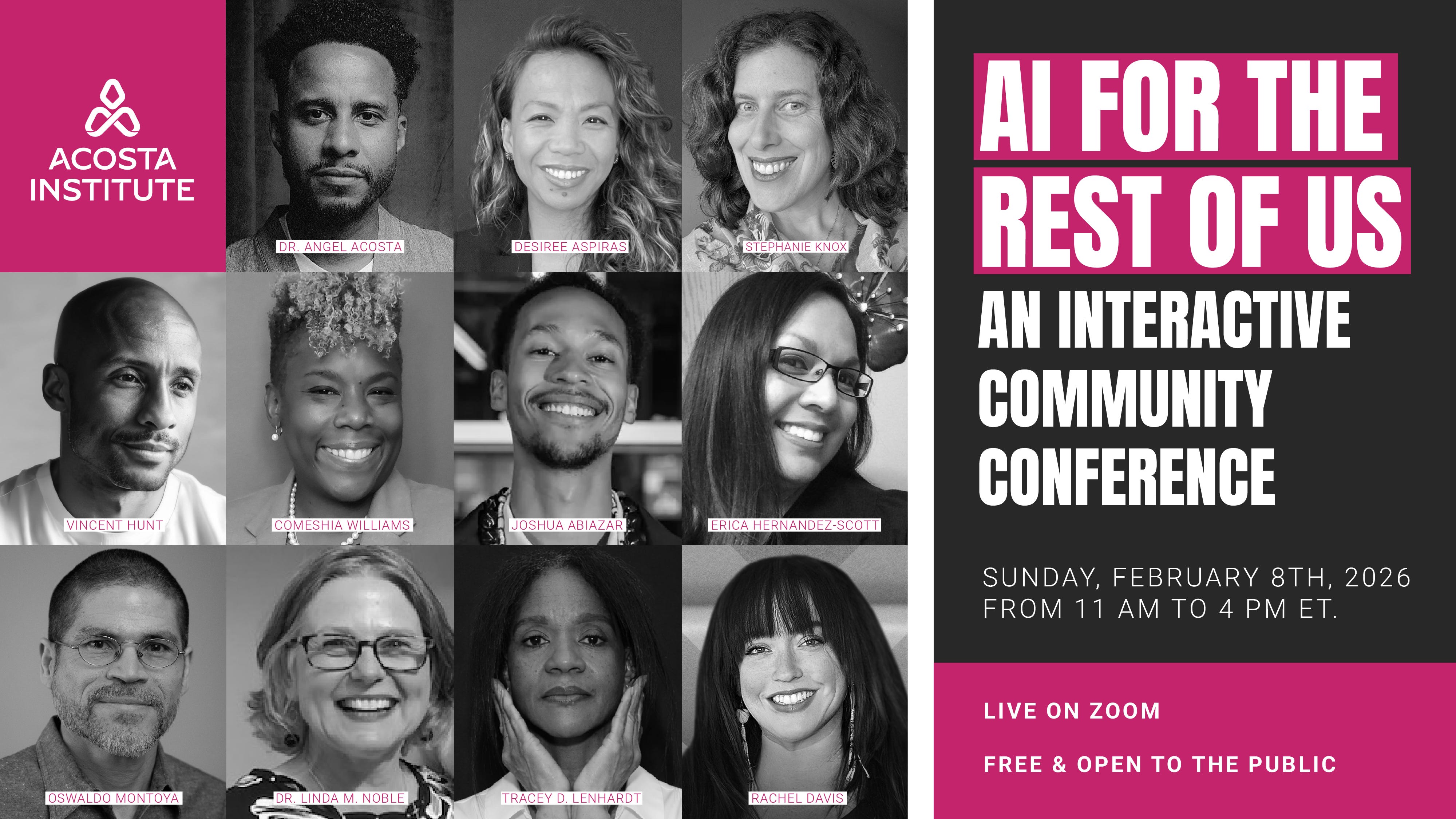
My session is at noon Costa Rica time, and I will be on a panel talking about how I have been engaging in inquiry and experiments with students about and with AI, and sitting at this edge of enchantment and disturbance.
You can also read more on our new series on AI, Peace and Education on Digital Peace, which starts by asking the question, “What is the role of education in the age of AI?”
I was also interviewed about my enagement with AI for Weaving Back the World, a recent publication from Ecoversities Alliance (the section with me starts on p. 120, but I recommend reading the whole thing!).
My engagement with AI is an expression of my practice of sitting with the mess and staying with the trouble1 of these times, and of trying to seed more peaceful, just, regenerative worlds from within and beyond the violent systems we have inherited and are complicit in. Connecting this back to the opening meditation, meditating on this and looking deeply helps us to grow our capacity for sitting and staying. My engagement with AI is also a practice of relationality - through my engagement, I am trying to disrupt transactional and extractive habits and open up other possibilities for relating.
Thank you, dear reader, for sitting in this mess and staying with the trouble with me, which you are doing by being here and holding these questions with me.
I hope to see you at the conference!
With infinite love and care,
Stephanie
Unedited meditation transcript here:
Hello and welcome. I’d like to invite you into a short meditation on interbeing and technology. It’s a very windy day where I am, so you might hear some wind in the background.
And as you settle in, I just invite you to notice what sounds are present. in the environment and on the land that you’re on. And find a comfortable seat, or you could even do this lying down. And I invite you to take a couple of breaths just to settle.
To let yourself land. To notice how you’re arriving to the space. Start to notice your breathing.
And feel how it is to be breathing in this moment. And see if you can feel that you are breathing with the life around you as you breathe. That as you breathe in, you are taking in oxygen, that was given by the trees and plants around you.
And as you breathe out, you reciprocate, you offer carbon dioxide back to the earth, to the plants, to absorb. And for a few rounds of breath, follow your breathing in this way. Feeling and sensing into the fact that you are breathing with the life around you.
Breathing in with the trees, breathing out with the trees. And then start to bring your awareness to wherever you’re making contact with the earth. Or whatever you’re sitting or lying on is making contact with the earth.
And start to feel the earth, the land beneath you. Feel the solidity and stability that it offers. And feel yourself really rooted in this place.
And start to expand your awareness to feel this little patch of land where you are. As connected to our broader planetary home. Take your gaze out to feel yourself rooted to the earth.
That this place where you are resting right now is connected to all of life. Then start to bring your awareness to the device that you are listening to this on. Maybe it’s your phone or a computer.
You might even place the device in your hand if it’s not already there and feel its weight. Or perhaps simply rest your hand on it, or even just your attention. Start to tune in to this device.
And sense that this device, too, is from the earth. The rare earth minerals that have gone into its production. that exist within it, feel their weight. Imagine the distant lands where they may have come from.
The human hands that went into mining them, transporting them, manufacturing them into this device that you now hold. And as you sit with this device, which allows us to be connected, And allows you to connect with so many others, people and places around our shared planetary home. Can you also trace the many places, the elements, the hands, the labor, the energy that is contained within this device?
Dwelling with these connections. Can you hold simultaneously the beauty and the power? And also the gravity of the violence and destruction that goes in to creating these devices.
Holding the beauty and the weight of this connection. Begin to start to release this awareness. But as you do notice what emotions and sensations might be present, as you’ve moved through this exercise, as you’ve held this tension.
What is alive for you? What feelings are present? What sensations are alive in your body?
What do you notice? Start to take a few more deep breaths and perhaps start to open your eyes if they were closed. And depending on how this landed for you, you might want to take some time now to journal or write about your experience.
You might want to shake it off if you feel like you’re carrying any tension or weight from the exercise. And just notice how it felt to hold all of that. And now, notice what you want to do with that awareness.
Thank you for your practice.
This phrase comes from Donna Haraway, and I highly recommend reading the whole book by that title.